

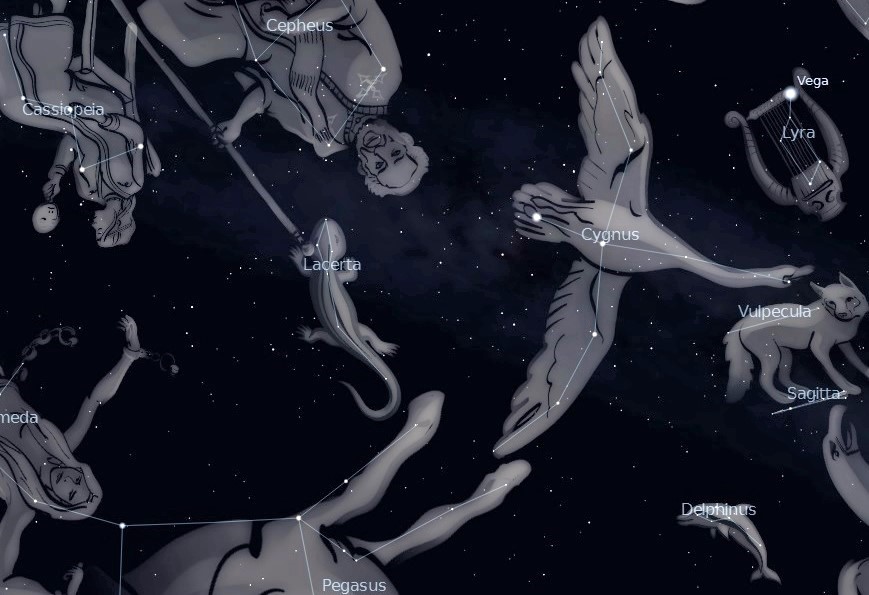
Salamanders aren’t the most noticeable of critters; you usually have to make an effort to find one. This is a good time to locate the obscure constellation of Lacerta the Lizard, but it will take some effort and a dark sky.
Camouflaged partly by the Milky Way, Lacerta is surrounded by Cepheus, Cassiopeia, Pegasus and Cygnus. A good pointer to it is the base of the Summer Triangle. Running a line from bright Vega to Deneb at the tail of Cygnus and extending it about the same distance puts you near the zigzag shape of the lizard. It is one of those dim constellations created in the late 17th century by Johannes Hevelius to fill in an “empty” section of the sky. At first he named it Stellio; a stellion being a newt with star-like spots found near the Mediterranean Sea. If you manage to catch Lacerta, give yourself a pat on the back and let it go.
This Week in the Solar System
Saturday’s sunrise in Fredericton is at 7:01 and sunset will occur at 7:43, giving 12 hours, 42 minutes of daylight. Next Saturday the Sun will rise at 7:09 and set at 7:29, giving 12 hours, 20 minutes of daylight.
The Moon is near Venus on Monday evening, near Antares on Thursday, and it is at first quarter on Friday. Mercury, the Moon, Spica and Venus are stretched out low in the west to southwest after sunset this weekend, with Mercury setting a half hour after the Sun and Venus an hour. Mercury’s motion over the week will be horizontal toward Venus, a challenging target with binoculars. Saturn rises an hour after sunset this weekend, becoming a prime star party target in telescopes. Mars zips toward a scenic line-up with the celestial Spartan twins Castor and Pollux in Gemini. Jupiter rises at 4 am this weekend, shortly after scintillating Sirius well to its right, and they maintain the same altitude all week. From rural areas the zodiacal light might be seen in the east an hour or two before sunrise.
Mount Carleton Provincial Park hosts a special astronomy-themed Dark Sky Experience weekend September 11-13. The Saint John Astronomy Club meets in the Rockwood Park Interpretation Centre this Saturday at 7 pm. The RASC NB Fall Star Fest takes place September 18-19 at Kouchibouguac National Park.
Questions? Contact Curt Nason here.


What do you think? Comment here