Editor’s Note: I’m pleased to introduce a new face and a new regular feature today. Curt Nason, who also grew up in my village, has agreed to share his knowledge of the skies with us each week in this timeslot. I’ll be the first to admit that I’m a novice but there’s a peace that comes from realizing we are part of something far greater than ourselves. I look forward to learning with all of you.
This Week’s Sky at a Glance, 2026 February 14 – February 21
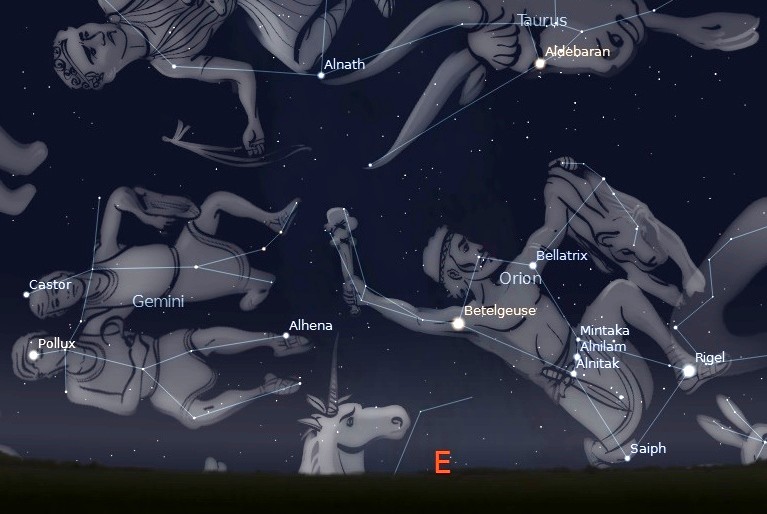
Let’s pay attention to the minority this week. By this I mean the Minor constellations: Ursa, Canis and Leo, all of which are now visible in the evening. Ursa Minor, the Little Bear, hosts the Little Dipper asterism and it has what is arguably the most important and famous star of the night sky–Polaris, the North Star–at the tip of its tail. Although smaller and less bright than the nearby Great Bear, Ursa Minor is at the centre of action in our night sky. How many have heard or even believe that Polaris is the brightest star in the night sky? It actually ranks at number 48.Canis Minor, the Little Dog, is noted for having the eighth brightest star, Procyon. An imaginary arrowhead formed by Orion’s head and shoulder stars points eastward to the Little Dog. We usually see it as just two stars so it is probably a wiener dog. Despite the brilliance of its luminary, the Little Dog is just the opening act for Canis Major and its leading star, Sirius, the brightest one of the night sky. In early winter Procyon rises first to announce the impending arrival of Sirius, hence the name which means “before the dog.”Leo Minor the Little Lion experiences difficulty in being noticed, and with good reason. It is one of those inconspicuous constellations created by the 17th century astronomer Johannes Hevelius to fill gaps in the sky. We see it as a triangle between the back of Leo and the feet of Ursa Major. To give it some distinction and pride we can imagine the lion cub nipping at the heels of the Great Bear to keep it from attacking Leo.
February 18 @ 6:30…
February 18 @ 6:30…
Unlock the Archives
Subscribe to our free newsletter to read posts older than 6 months!
NOTE: If you are already subscribed, please enter your email below.