

This is the time of year when the evening sky seems static; the stars appear to be in the same place night after night in twilight. With reference to the stars Earth rotates once every 23 hours, 56 minutes and 4 seconds – a sidereal day. But since our clocks are based on a 24-hour mean solar day rather than the sidereal day, the stars rise about 4 minutes earlier each evening. The rate of earlier sunsets this time of year cancels half of that. Although the stars rise earlier we also see them sooner.
The opposite occurs in spring when the later sunsets add to the earlier rising of stars. The constellations seem to fly past over a month or two. Earth’s motion around the Sun results in many of the constellations being seasonal. For example, we currently see Orion in the southeast before sunrise. Come January it will be there after sunset and stick around in the evening sky until mid-spring. Those constellations near the north are circumpolar, meaning they never set and we see them year round.
This Week in the Solar System
Saturday’s sunrise in Fredericton is at 6:52 and sunset will occur at 7:57, giving 13 hours, 5 minutes of daylight. Next Saturday the Sun will rise at 7:01 and set at 7:43, giving 12 hours, 42 minutes of daylight.
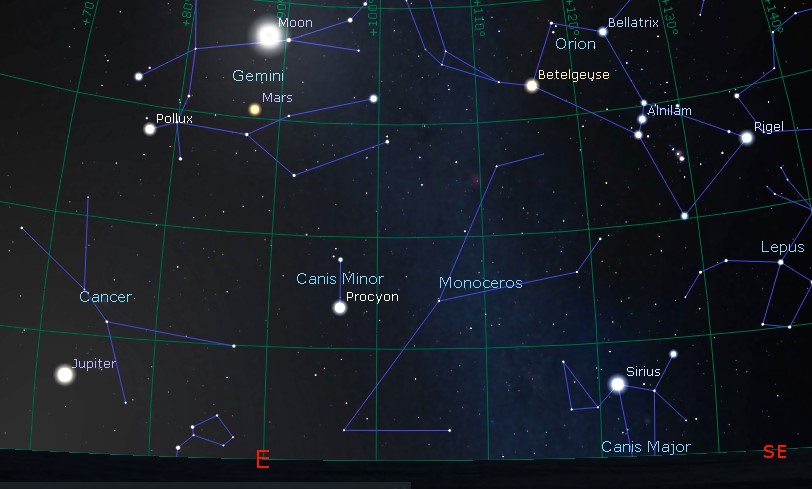
The Moon is near Mars on Sunday morning, near the Beehive star cluster and above Jupiter Tuesday, and it is new on Thursday. Venus and Spica set together before 9 pm over the week, with Venus pulling away to the left. Saturn is less than a month from opposition so it is high enough for grand telescope views late in the evening. By the end of the week Mercury stands a mere four degrees above the western horizon at sunset, setting less than half an hour later. Rising three hours before sunrise, Jupiter and Sirius rival each other in the east and southeast, respectively, with Procyon above and between them and Mars to its upper left in Gemini. On Tuesday afternoon the Moon passes in front of Jupiter in the west around 3:54 and releases it just under an hour later. From rural areas the zodiacal light might be seen in the east an hour or two before sunrise starting late in the week.
The Fundy Park Stargaze this weekend has been cancelled due to the weather forecast. The Fredericton Astronomy Club resumes meetings in the UNB Forestry-Earth Sciences building on Tuesday at 7 pm. Mount Carleton Provincial Park will host a special astronomy-themed Dark Sky Experience weekend September 11-13. The Saint John Astronomy Club will meet in the Rockwood Park Interpretation Centre on September 12 at 7 pm.
Questions? Contact Curt Nason here.



What do you think? Comment here